


The fitness equipment specs for upload teams go beyond product names and prices. What your team needs includes dimensions in two states, the product's weight for shipping calculations, user capacity specs from the manufacturer, and a decision on whether different weight values should be separate products or variants. Send these in writing before work starts, and the team has everything it needs to list each item correctly.
Key takeaways
- Provide dimensions in both assembled and boxed states: assembled specs go on the product page, and boxed specs feed Shopify's shipping calculations.
- Weight increments for free-weight equipment (dumbbells, kettlebells, weight plates) usually require separate product listings rather than variants, because each weight value carries its own GTIN and a different shipping weight.
- Safety specs such as maximum user weight capacity are entered as supplied from the manufacturer, without modification or interpretation.
- Motorized equipment needs power and connectivity details noted separately from physical specs.
- Use the brief template at the bottom of this article to gather everything before handing off.
Fitness equipment specs for upload teams: what the brief includes
The fitness equipment specs for upload teams fall into four groups: physical and shipping specs, weight-increment structure, safety and performance data, and electrical specs for motorized products.
A complete brief gives the upload team a single source to work from without going back to you for clarifications. For a range of, say, 30 to 50 products, that means one document with consistent columns, every spec labeled, and units stated once at the top.
If you haven't put together a product data brief before, What to Send Your Upload Team Before a Shopify Job covers the general format and file structure.
Fitness equipment specs: dimensions and shipping
Fitness equipment is different from most product categories because a single item can have very different measurements depending on its state. A treadmill assembled and ready to use might measure 180 × 85 × 140 cm (71 × 33 × 55 in). The same treadmill packed into its shipping box might measure 185 × 90 × 30 cm (73 × 35 × 12 in), folded flat.
Your upload team uses assembled dimensions for the product description and attributes. It uses boxed dimensions to populate Shopify's shipping data, which Shopify uses to calculate rates when dimensional weight pricing applies (as of November 2026, per Shopify's product weight documentation).
Include both states in your brief, labeled clearly:
- Assembled dimensions: H × W × D in centimeters, with inch equivalents
- Boxed dimensions: H × W × D in centimeters, with inch equivalents
- Product weight: the item's weight in kg and lb as sold (not packed)
- Shipping weight: the total packed weight in kg and lb
For heavy items, typically over 25 kg (55 lb), note whether the product ships by freight carrier rather than standard courier. Upload teams flag this in Shopify's shipping profiles. Without that note, the wrong rate may apply at checkout. The same two-state approach applies to furniture dimensions for upload teams, where a table's footprint and boxed dimensions are equally distinct.
Weight increments as variants or separate products
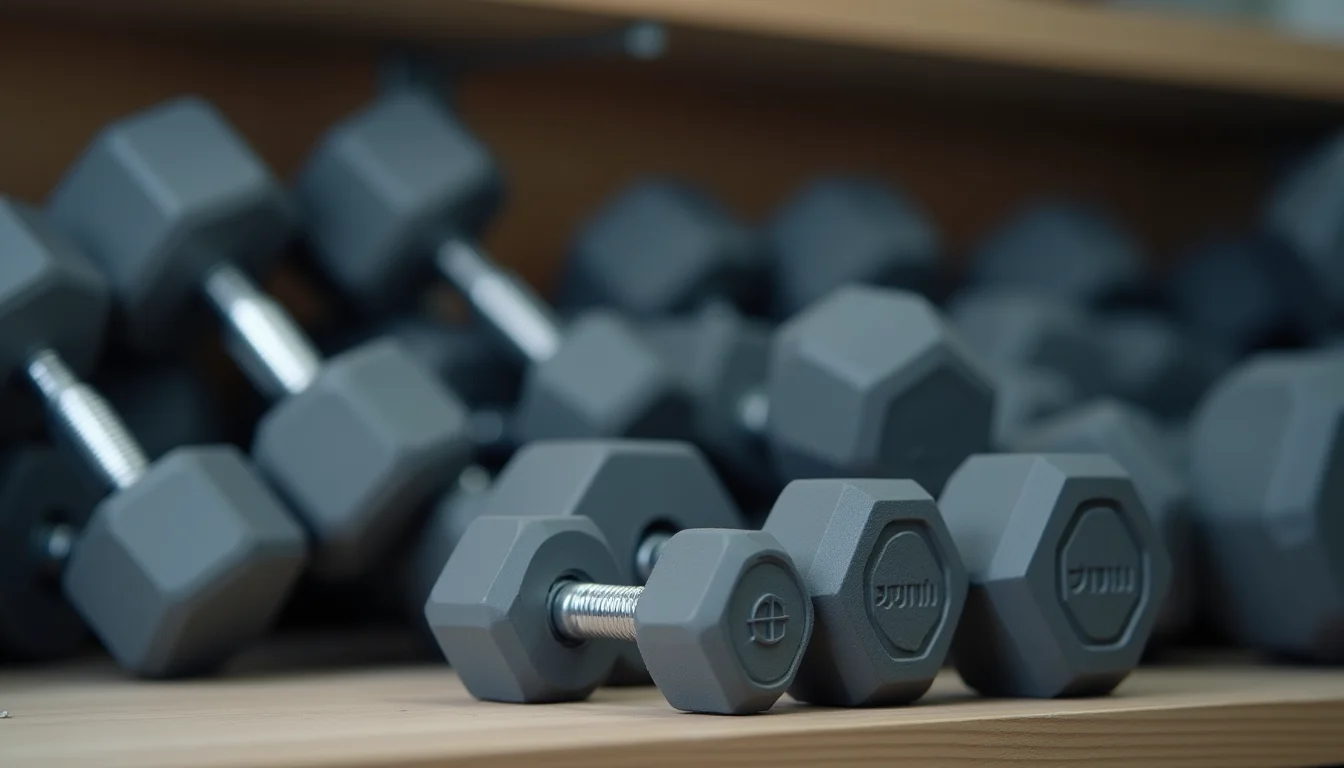
This is the most common structure decision in a fitness equipment brief. If your store sells rubber hex dumbbells in weights from 2 kg to 60 kg, should each weight be a variant of one Shopify product, or its own separate listing?
The answer depends on whether each weight value has its own GTIN, the barcode that identifies a specific product at a specific unit level (per GS1 barcode standards). Different GTINs signal different products to Shopify's inventory system, to shipping carriers, and to marketplace channels.
For most free-weight equipment, different weight values are sold in separate packaging with separate barcodes. A 10 kg dumbbell and a 20 kg dumbbell are different items to a carrier: different shipping weights, often different packaging, and different GTINs. As a rule, when weight increments come with different GTINs and different shipping weights, they need separate product listings.
This matters because Shopify allows up to 3 options per product and up to 100 variants total (as of November 2026, per Shopify's variants documentation). Using weight as a variant option works only when the increments genuinely represent the same purchaseable unit in different sizes, with no GTIN difference. For a set of adjustable dumbbells sold as one item with a weight range option, a variant makes sense. For a range of fixed-weight dumbbells each sold and packaged separately, it does not.
Include in your brief:
- Whether each weight value has its own barcode
- Whether each weight is sold and shipped as a separate unit
- Whether any items in the range are genuinely one product, such as an adjustable set
Safety and performance data
Fitness equipment often carries specs that are safety-related rather than purely descriptive: maximum user weight, maximum recommended session duration, minimum floor space, and warranty period. Include these in your brief exactly as the manufacturer states them. Upload teams enter them as supplied, without modification.
Include:
- Maximum user weight capacity: in kg and lb (for example, "120 kg / 265 lb")
- Safety certifications: any marks listed on the packaging, such as CE, FCC, or RoHS, recorded as supplied
- Warranty period: from the manufacturer's documentation (for example, "2 years frame, 1 year electrical components")
- Assembly required: yes or no
Do not add commentary or compliance language. If a certification mark appears on the packaging, record it. If it doesn't, leave the field blank. The same as-supplied principle applies to supplement label data for upload teams and other health and wellness categories: upload teams record what the manufacturer states, nothing more. For more on how our team handles this category, see our health and wellness product upload service.
Motorized and electronic equipment
Treadmills, stationary bikes with digital consoles, rowing machines, and similar products carry additional specs your upload team needs for product attributes and body copy.
Include:
- Motor rating: in HP or watts, as stated by the manufacturer
- Voltage and frequency: 240V / 110V and 50 Hz / 60 Hz
- Connectivity: Bluetooth version, Wi-Fi standard, or app compatibility (for example, "Bluetooth 5.0, compatible with the brand's training app")
- Console: screen size in inches and screen type (LCD or touchscreen)
- Maximum speed or resistance levels: the highest value as stated in the spec sheet
Record what the manufacturer publishes. Upload teams enter these as product attributes or in a dedicated section of the product description, depending on the store's template.
The fitness equipment brief template
Copy this table into a spreadsheet or document and fill it in for each product. Add rows as needed for your range.
| Spec category | What to include | Example value |
|---|---|---|
| Assembled dimensions | H × W × D in cm and inches | 140 × 85 × 180 cm (55 × 33 × 71 in) |
| Boxed dimensions | H × W × D in cm and inches (packed) | 30 × 90 × 185 cm (12 × 35 × 73 in) |
| Product weight | kg and lb (item only, not packed) | 62 kg (137 lb) |
| Shipping weight | kg and lb (packed) | 71 kg (157 lb) |
| Freight flag | Yes or no (flag if over ~25 kg) | Yes |
| GTIN / barcode per SKU | One GTIN per weight or size (EAN or UPC) | 9312345678901 |
| Separate product or variant? | Decision for each weight or size increment | Separate (different GTIN per kg value) |
| Max user weight capacity | kg and lb as stated by manufacturer | 120 kg / 265 lb |
| Certifications | As listed on packaging | CE, RoHS |
| Warranty | As stated in documentation | 2 years frame, 1 year electrical |
| Motor rating (if applicable) | HP or W as stated | 2.5 HP |
| Voltage and frequency | V and Hz | 240V, 50 Hz |
| Connectivity | Bluetooth version, app name | Bluetooth 5.0 |
For Shopify product data entry across a fitness equipment range, a completed brief like this cuts the back-and-forth considerably. The more complete it is before you send it, the faster the team can move through the range.

Frequently asked questions
Should dumbbells in different weights be variants or separate products?
In most cases, separate products. If each weight value has its own GTIN (a different EAN or UPC barcode), different packaging, and a different shipping weight, it should be a separate Shopify product with its own listing. Shopify variants are designed for options that represent the same product in different sizes or colors, not different items with different barcodes and different shipping weights. Confirm the structure by including the GTIN and shipping weight for each increment in your brief.
Do I need both assembled and boxed dimensions for every fitness product?
Yes, unless the product ships pre-assembled or flat-packed with no assembly. Assembled dimensions appear on the product page so customers know if the item fits their space. Boxed dimensions are what the carrier uses to calculate freight charges. If you only have one state, label which it is so the upload team knows what it's working with.
What if the manufacturer specs are only in metric or only in imperial?
Provide whatever you have. Upload teams can convert units, but it helps to note which unit is the original so they can confirm any conversion before publishing. For products sold in markets that expect both, giving the source measurement and noting the target markets lets the team format consistently across the range.
How should I handle certifications for fitness equipment?
Record certification marks exactly as they appear on the product packaging or the manufacturer's spec sheet. The upload team enters them as supplied. Do not add or remove certifications based on expectations. If a mark isn't confirmed on the product, leave the field blank.
Does a treadmill's app compatibility need to go in the product title?
No. App compatibility and connectivity details belong in product attributes or a dedicated section of the product description, not in the product title. Titles are for the item name, key specs such as motor size or resistance levels, and any variant-defining attributes. Connectivity goes into the body content where customers look for it.