
Fishing gear data for Shopify catalog listings covers more fields than most product types. A rod alone requires length, action, power, line weight rating and lure weight before the listing is complete, and none of those fields appear in a standard product template. This guide covers every specification an upload team typically needs you to define before work starts on a fishing products catalog.
Key takeaways
- Fishing rods need six technical fields beyond title and price: length, action, power, number of pieces, line weight rating and lure weight.
- Reels require gear ratio, line capacity, ball bearing count and max drag weight to populate variant and specification fields correctly.
- Lures and tackle need weight, hook size and lure type or bait style depending on category.
- Upload teams need this data settled before the job starts; missing specs lead to variant errors that require a second pass.
- Group your specification data by product type before sending it, since rod data, reel data and tackle data are structured differently in Shopify.
Fishing gear data for a Shopify catalog: the core fields
Fishing products carry technical specification data that most other retail categories do not use. Where a clothing item needs size and color, a fishing rod needs length, action and power rating. Where a supplement needs serving size and flavor, a reel needs gear ratio and line capacity.
This complexity makes fishing one of the more preparation-intensive categories for a Shopify product data entry job. Upload teams ask for this data upfront because entering incomplete listings and then correcting them later takes longer than setting up the data model correctly from the start. The more complete your spec sheets before the job begins, the cleaner the catalog comes out.
Rod specifications to prepare for Shopify
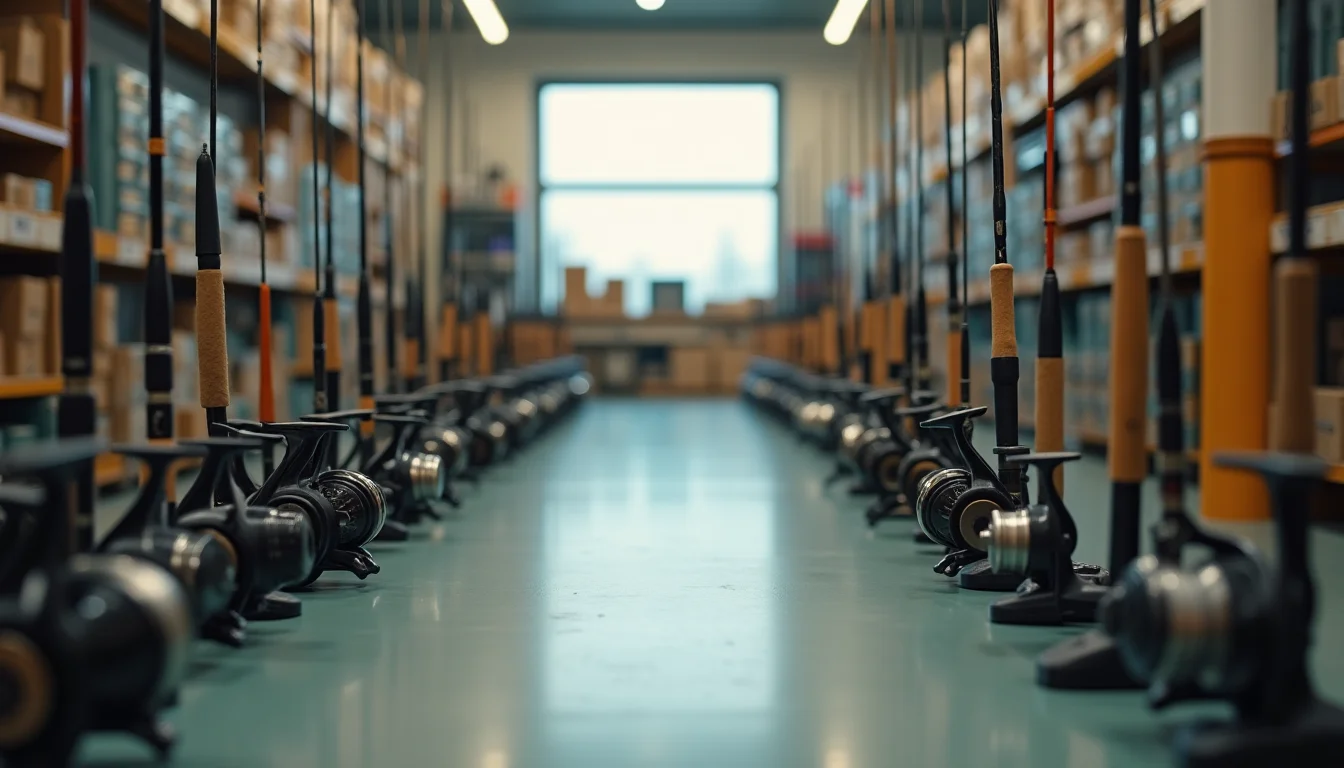
Rods are the most data-rich product type in a fishing catalog. A single rod SKU typically requires all of the following before an upload team can build an accurate listing.
| Field | What to include | Example value |
|---|---|---|
| Rod length | Total length in feet and inches, as printed on the blank | 7'0" |
| Rod action | How the rod bends: Fast, Medium-Fast, Medium, Slow | Medium-Fast |
| Rod power | Strength class: Ultra-Light through Extra-Heavy | Medium-Heavy |
| Number of pieces | How many sections the rod breaks into | 2-piece |
| Line weight rating | Recommended line weight as a lb test range | 10-20 lb |
| Lure weight rating | Recommended lure weight as an oz range | 3/8-1 oz |
| Blank material | Graphite, fiberglass, composite or carbon fiber | High-modulus graphite |
| Handle type | Cork, EVA foam, split grip or full grip | Split-grip cork |
| Guide material | Stainless, ceramic-insert, titanium | Stainless with ceramic inserts |
For variant structure: if your store sells the same rod model in multiple lengths or actions, those become Shopify product variants. A 7-foot and 6'6" version of the same model are variants, not separate products. If a model ships in one length but three actions, action is the only option. Settling this before the upload avoids half-built variant sets. See the section on sporting goods sizes by sport for upload teams for how size and specification variants are handled across other sporting goods categories. If you stock a broader range of sporting goods, our sporting goods catalog service covers how upload teams approach different equipment types.
Reel data and tackle fields
Spinning and baitcasting reels
Reel fields follow a consistent pattern across spinning, baitcasting and trolling types, though the specific values differ.
| Field | What to include | Example value |
|---|---|---|
| Reel type | Spinning, baitcasting, trolling, fly, spincast | Spinning |
| Gear ratio | Retrieve ratio expressed as X:1 | 6.2:1 |
| Line capacity | Mono in lb/yards and braid in lb/yards | 8 lb/230 yd mono; 20 lb/300 yd braid |
| Ball bearings | Number of shielded ball bearings plus roller bearing | 7+1 |
| Max drag | Maximum drag force in lb | 17.6 lb |
| Retrieve speed | Inches per turn (IPT) | 29 IPT |
| Reel weight | Body weight in oz | 8.1 oz |
| Handedness | Right-hand, left-hand or ambidextrous retrieve | Right-hand retrieve |
Lures, hooks and terminal tackle
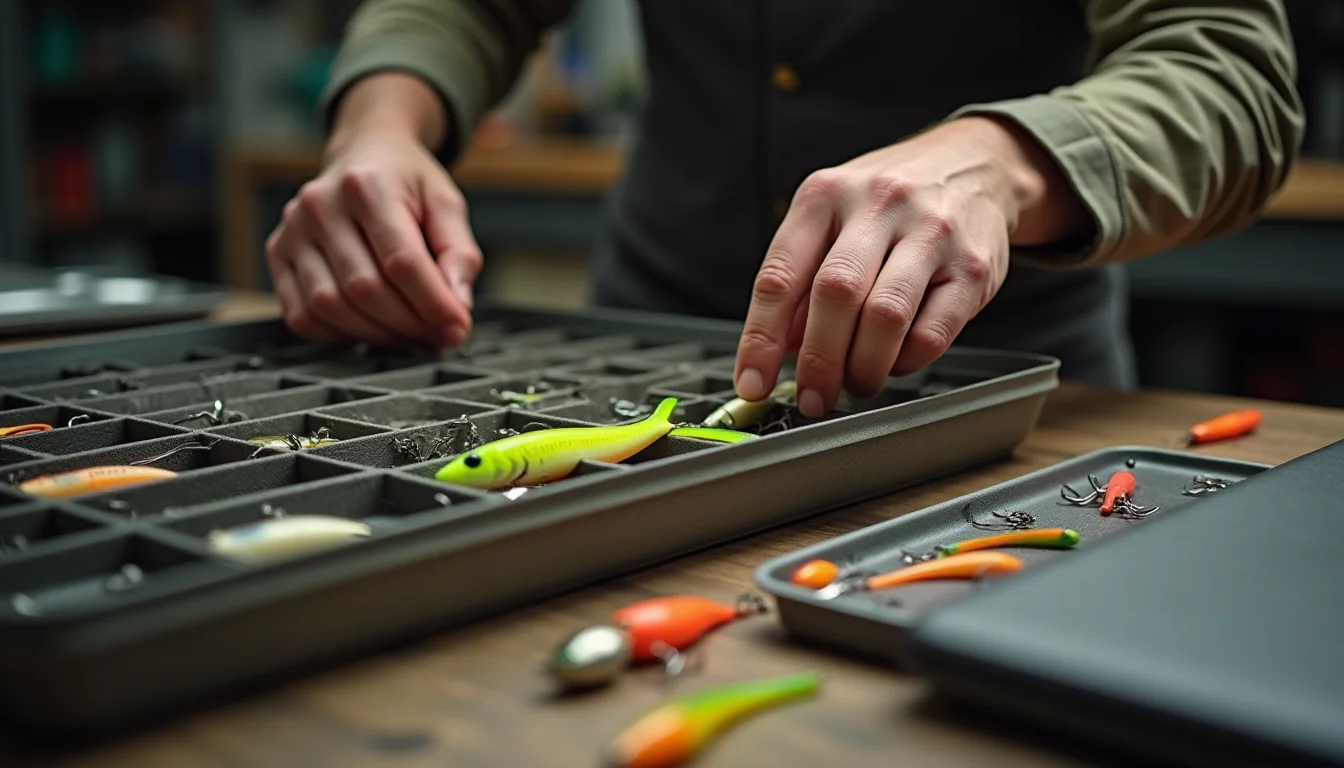
Tackle categories each have their own key fields.
| Category | Key fields | Example values |
|---|---|---|
| Hard lures | Length, weight, lure type, diving depth, hook count, hook size | 3.5", 1/2 oz, crankbait, 3-6 ft depth, 2x treble #6 |
| Soft plastics | Length, weight, style, quantity per pack, hook recommendation | 5", 3/16 oz, paddle tail, 10 pack, 3/0 hook |
| Jigs | Weight, hook size, style, skirt material | 1/4 oz, 2/0 hook, swim jig, silicone skirt |
| Hooks | Style, gauge/size, material, quantity per pack | EWG offset, 3/0, high-carbon steel, 10 pack |
| Fishing line | Type, test weight, breaking strength, length, material | Monofilament, 12 lb test, 300 yd, nylon |
Variants and options for fishing gear in Shopify
Fishing gear has non-standard variant patterns compared to other categories. As of November 2026, Shopify allows up to three options per product and up to 100 values per option, as documented in Shopify's product variants guide.
For rods: a model sold in three lengths and two actions creates six variant combinations, so you need two options (length and action). If a rod comes in one action but three lengths, one option is enough. Deciding which attributes create variants, and which are simply spec fields in the description, is part of the data model setup an upload team typically needs you to confirm.
For reels: handedness (right-hand vs left-hand retrieve) is a common variant option on the same SKU. Some retailers list them as separate products if images differ. Either approach works, but the team needs a consistent rule across the catalog.
For lures: color and size are typical options. Pack quantity (single vs 10-pack) may be a variant if each pack size has its own barcode, or a separate product if the two are priced and stocked independently. Knowing this in advance prevents rework after upload.
What to prepare before briefing your upload team
For a smooth handoff on a fishing products catalog, have the following ready. See what to send your upload team for a broader checklist that applies across all catalog types.
- Product titles that follow your naming convention, for example Brand + Model + Length + Action for rods, or Brand + Model + Reel Type for reels
- A specification sheet or CSV with the technical fields above, one row per SKU
- Product images organized per SKU or colorway, with file names that map to your SKUs
- Supplier PDFs or spec sheets for any missing fields
- Variant structure decisions for each category: which attributes create variants versus separate products
- Kit and combo details for any rod and reel combo products, including the full specs of each included item
Preparing this before briefing the team means the first batch goes in correctly and you spend less time on correction rounds. Our sports and outdoor product upload service handles the full upload job once you have the data organized.
Frequently asked questions
Do I need metafields for rod and reel specifications on Shopify?
Not always. For small fishing catalogs, fields like rod action and line weight can sit in the product description. For larger stores with technical buyers who filter by spec, metafields let you add filter functionality to collection pages. The right choice depends on your store's navigation design, which is worth confirming before the upload starts so the data is structured consistently from day one.
How should rod and reel combos be listed on Shopify?
Rod and reel combos are typically a single product with a combo title, with each component's key specs listed in the description or a metafield. Upload teams need the full spec data for both items to write an accurate description. If the rod and reel are also sold separately, they stay as individual products, and the combo is a separate listing that references or describes both. Decide the approach before the upload job starts so the team can enter data consistently.
What counts as a Shopify variant for fishing lures?
Color and size are the most common lure variants, since the same lure model in a different color or weight has its own barcode and stock level. Pack quantity, for example a single versus a 10-pack, may be a variant if each has a separate barcode, or a separate product if images or pricing structures differ significantly. Settling the variant rule before upload prevents duplicate entries and mismatched stock figures.
Do fishing lines with different spool lengths need separate SKUs?
Yes, in most cases. A 100-yard spool and a 300-yard spool of the same line type and test weight have different barcodes and prices. Upload teams list these as variants of the same product using a spool length option, or as separate products if images differ. Either approach is valid as long as it is applied consistently across the full line range. See Shopify's product details documentation for how product options and variants are structured.