

Take a supplier spreadsheet with 200 pieces. It has names, prices and a photo reference number for each item, but no metal type, no karat, no stone details and no ring sizes. For a jewelry store, that is not enough to start an upload.
Jewelry product data for Shopify upload covers the standard product fields every listing needs plus a second layer of metal, gemstone and size attributes that are unique to this category. This guide covers what each field contains and what to gather before an upload starts.
Key takeaways
- Jewelry listings regularly need 8 or more category-specific fields that do not appear in a standard Shopify product template, including metal type, purity, gemstone details and size measurements.
- Metal purity and gemstone data must come from supplier documentation: an upload team cannot infer them from product names or photography alone.
- Ring sizes and chain lengths are entered as Shopify variant options, not plain text; the size scale (US, AU/UK, EU or inside diameter in mm) must be agreed before the first row is entered.
- Which fields become Shopify variants and which belong on separate listings is a structural decision that shapes the entire catalog; getting it right at the start avoids rebuilding later.
- A supplier spreadsheet with every field labeled and filled in cuts around 30 to 40 minutes per 100 SKUs during upload.
The standard fields every product listing needs
Every Shopify product, regardless of category, requires the same core set of fields: product title, description, vendor, product type, tags, price, compare-at price, SKU, barcode (if applicable) and product images. These do not change for jewelry.
What does change is the layer of category-specific data underneath. Jewelry has more of these additional fields than almost any other product type, and several of them feed directly into the variant structure, which means they need to be settled before upload starts, not filled in afterward.
Core jewelry product data fields for Shopify upload
Metal type and purity
Every metal piece needs both a metal type and a purity value.
Metal type names the material: yellow gold, white gold, rose gold, sterling silver, platinum, stainless steel, titanium or plated metal. The supplier's product naming usually includes this, but it should be in a dedicated field, not buried inside a long product title.
Metal purity is the karat or fineness mark:
| Metal | Common purity marks |
|---|---|
| Gold | 9ct (375), 10ct (417), 14ct (585), 18ct (750), 22ct (916), 24ct (999) |
| Silver | 925 (sterling), 950, 999 (fine silver) |
| Platinum | 850, 900, 950, 999 |
| Plated | Note the base metal and plating (for example, gold-plated over brass) |
Shopify does not have a built-in purity field (as of November 2026). It typically lives in a metafield or in the product description. Decide before upload which approach your store uses, so the data lands in the right place every time.
Gemstone data
For any piece with set stones, include:
- Stone type: diamond, ruby, sapphire, emerald, amethyst, topaz, turquoise, opal, moissanite, cubic zirconia or crystal
- Stone cut: round brilliant, oval, cushion, princess, pear, marquise, emerald cut, asscher
- Carat weight: stated in decimal form (0.25 ct, 0.50 ct, 1.00 ct)
- Treatment: natural or heat-treated for colored stones; natural or lab-grown for diamonds and moissanite
- Clarity and color (for diamonds): optional for most stores, but needed when you are selling stones graded by GIA or IGI
Fashion and costume jewelry uses simulated stones (crystal, synthetic stone, glass) rather than natural gemstones. These still need a stone type field. Calling them "rhinestone" or "crystal accent" is accurate and sets the right expectation.
A piece with no stones (a plain band, a chain, a locket without stones) does not need any gemstone fields. Leave them out rather than leaving them blank.
Size and measurement fields
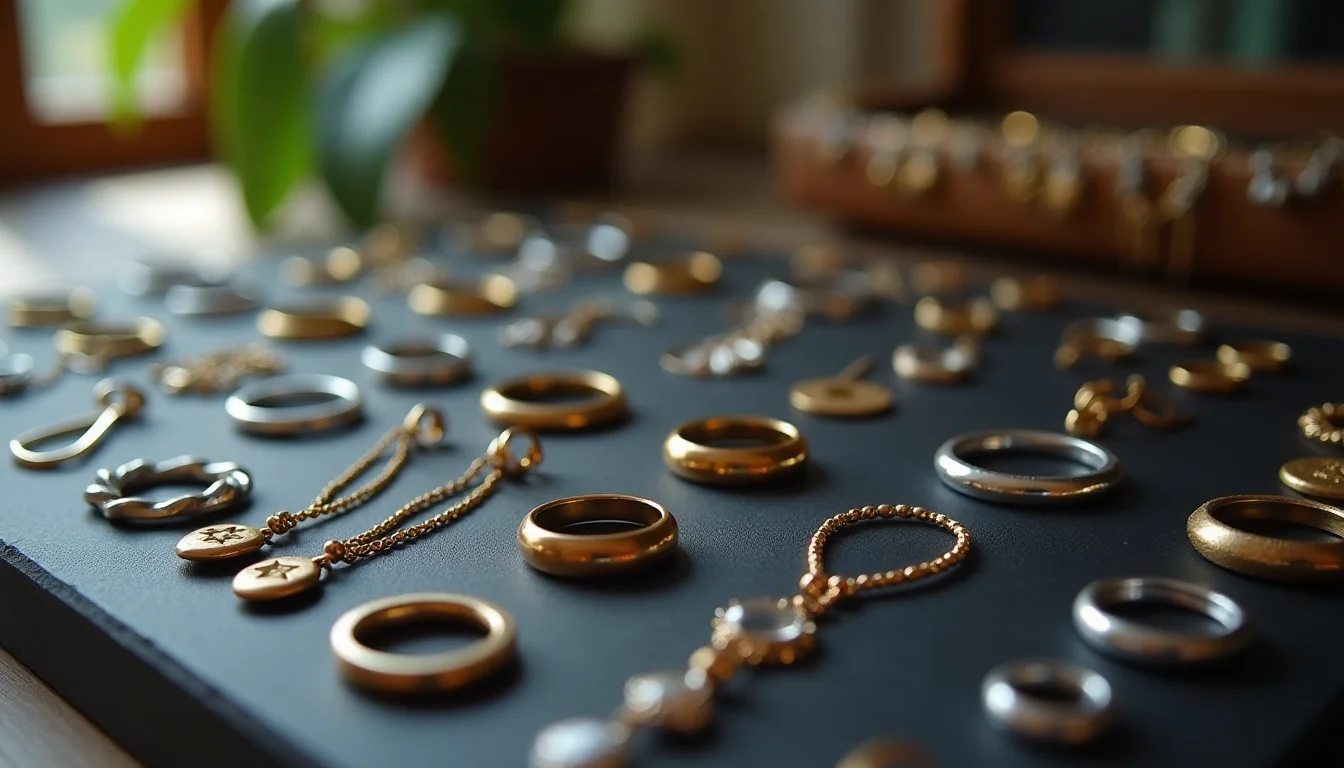
Jewelry sizing is more varied than most categories, because different piece types use different measurement conventions.
Rings use a size scale, and multiple scales are in common use:
- US/Canada: numerical (5, 5.5, 6, 6.5, 7...)
- UK/Australia: alphabetical (J, K, L, M, N...)
- EU: numerical but different values (49, 51, 52, 54, 56...)
- Inside diameter in mm: the most universal
Agree on which scale to use before upload starts. If you serve international customers and want to list multiple scales, that belongs in the description or a size guide; variant titles should use one consistent scale.
Necklaces and chains are measured by length: 14 in, 16 in, 18 in, 20 in, 22 in, 24 in or the equivalent in centimetres. Chain style (cable, curb, box, rolo, snake) is a secondary field worth including.
Bracelets list length in inches or centimetres. The clasp type (lobster, toggle, spring ring, magnetic, bayonet) is a useful secondary field.
Earrings use drop length from the base of the stud or ear wire to the bottom of the piece. Some stores also note the earring back type (butterfly, screw, latch, hoop).
Pendants and charms list the face dimensions in mm (width by height) and the bail opening size if buyers may supply their own chain.
Variant structure for jewelry
Deciding which fields become Shopify variants is the most consequential data decision in a jewelry upload. Getting it wrong means rebuilding the entire catalog structure.
The general rule is that variant options represent the choices a buyer makes when purchasing that specific piece. Fields that differ between products belong on separate listings.
| Field | Make it a variant? | Notes |
|---|---|---|
| Ring size | Yes | The buyer chooses a size; it is a purchase option |
| Chain length | Yes, if stocked in multiple lengths | If only one length is available, note it in the description |
| Metal type (same design) | Yes | Yellow gold, white gold and rose gold versions of the same ring are variants of one product |
| Metal purity (same type) | Sometimes | 9ct and 18ct of the same design can be variants, but only when the styling is identical; different pricing logic or appearance usually means separate products |
| Different stone type | No | A sapphire ring and a ruby ring are separate products (different value, different look) |
| Carat weight | No, usually | Different carat weights change the piece substantially; most stores list them separately |
Shopify allows up to three option types per product, with a default limit of 100 variants per product. Jewelry often uses all three options (for example, metal type combined with ring size and stone color on a fashion piece). Confirm the variant structure with your team before upload starts, because the architecture must be built from scratch if it changes after the catalog is live.
What to send your upload team
Before briefing a Shopify product data entry team, provide this information for each piece:
| Data point | Source | Format example |
|---|---|---|
| Metal type | Supplier spec sheet | "14ct Yellow Gold" |
| Metal purity | Supplier spec sheet or hallmark | "585" or "14ct" |
| Gemstone type | Supplier spec or certificate | "Natural Ruby" |
| Carat weight | Certificate or supplier spec | "0.50 ct" |
| Ring size range | Supplier size chart | US 5 to 12 (whole and half sizes) |
| Chain length options | Supplier spec | "16 in, 18 in, 20 in" |
| Clasp type | Supplier spec | "Lobster clasp" |
| Hallmark | Physical piece or certificate | "925" |
A template with these fields, pre-filled by your supplier or buyer, cuts the time needed to verify and format data before upload. If certain fields are missing (carat weight is a common gap), flag them before upload starts rather than leaving them blank or guessing. For the broader briefing process, the guide on seasonal range photography for upload teams covers how to prepare a full handover.
If you want to get the first batch right, sending a sample of 10 to 20 pieces with complete data is a practical first step. For product uploads for new ranges, that groundwork is the difference between a two-day job and a week of back-and-forth corrections.
The image standards guide for jewelry on Shopify covers the visual side of a jewelry listing, which pairs directly with the data work covered here.
Frequently asked questions
Does every jewelry listing need gemstone fields?
No. Plain metal pieces (chains, plain bands and signet rings without stones) do not need gemstone fields. Only add stone data when the piece has set or featured stones. Leaving gemstone fields out is cleaner than populating them with "none" or "N/A".
Should ring sizes be Shopify variants or just mentioned in the description?
Ring sizes should be Shopify variants when you stock multiple sizes. The customer selects a size at checkout and receives that size. A size guide page is a helpful supplement, not a replacement for variant options. If you only stock one size, note it in the description and skip the variant.
What if the supplier does not provide carat weight or gemstone certificate?
Do not estimate or approximate it. Leave the field blank and flag the gap in the brief before upload starts. Carat weight and gemstone grading affect perceived value and trust; an incorrect figure does more damage than an absent one.
How do you handle pieces with multiple stone types?
Create a single listing per piece. Enter the dominant or featured stone as the primary gemstone field. List secondary stones in the description: for example, "set with a central emerald and four diamond accents." If the piece is sold with interchangeable stones, those become variants.
What is a hallmark and should it appear on the product listing?
A hallmark is the official purity mark stamped into precious metal (925 for sterling silver, 585 for 14ct gold). Include it in the product description or a custom metafield. Hallmarks build buyer confidence and are a legal requirement for precious metal sales in some markets, including the UK for silver, gold and platinum items above minimum weights when described as such.