

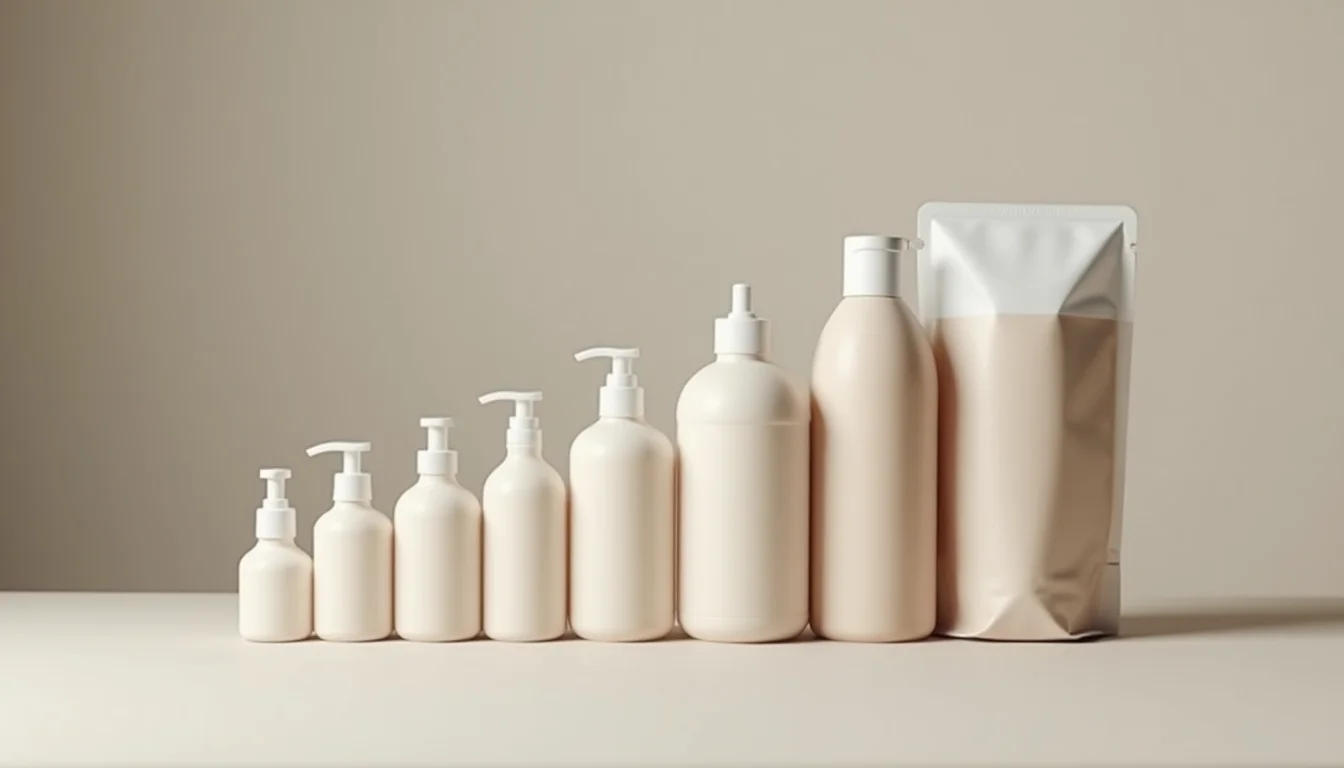
Say a supplier sends the same shampoo in 300 ml, 1 L, and 5 L. No formula notes, no GTINs for the larger sizes, no indication whether the 5 L is a salon refill or retail. That spreadsheet isn't ready for an upload team. Haircare refill sizes for upload teams need format and formula decisions before data entry can start.
Key takeaways
- Professional and salon sizes are not automatically variants of the retail product. If the formula differs (concentrate vs. ready-to-use), they should be separate listings.
- The clearest signal is the GTIN: different barcodes for the same product name usually mean separate Shopify products, not size variants.
- Refill packs need their own product data: a distinct title, their own GTIN, and a note in the brief on what base product they fit.
- Shopify allows up to 3 option types per product. Scent and size work well as two options. Adding a third variable (such as format) usually signals a need to split the range into separate product listings instead.
- As of October 2025, Shopify allows up to 2,048 variants per product, up from the previous limit of 100. Large haircare ranges rarely hit this, but the structural decision (variants vs. separate listings) matters more than the count.
Why haircare size formats need their own upload brief section
Most beauty categories have one or two size options. A moisturizer comes in 50 ml and 100 ml. A fragrance comes in 30 ml, 50 ml, and 100 ml. The sizes are the same formula, different quantities, and the variant structure is straightforward.
Haircare ranges, especially professional or salon lines, often have formats that do not follow this pattern. A shampoo might come in a 300 ml retail bottle, a 1 L professional bottle, a 5 L salon refill drum, and a 500 ml concentrate. These are not four sizes of the same product. The concentrate has a different formula, different instructions, and a different audience. The 5 L drum may not be sold retail at all.
Without clarity on what each format is, the upload team can't build the listing structure. The brief needs to resolve this before work starts.
Retail, salon, and refill formats: variants or separate products?
The question is not about size. It's about formula and audience.
| Format | Same formula as retail? | Shopify approach |
|---|---|---|
| Retail size (250 ml, 300 ml) | Yes (the baseline) | Base product listing |
| Salon size, same formula (1 L, 2 L) | Yes | Size variant on the retail product |
| Salon size, concentrate formula | No | Separate product listing |
| Refill pouch or carton | Usually yes | Separate product (different GTIN, different packaging) |
| Travel or trial size (30 ml, 50 ml) | Yes | Size variant, or separate product if excluded from the main catalog |
| Unlabeled bulk container (OEM) | Often a different batch | Confirm scope before including in catalog |
One reliable check: look at the GTINs. If a 1 L salon size and a 300 ml retail bottle carry different EAN or UPC codes, they are different products for inventory, purchasing, and fulfillment purposes. Upload them as separate listings. If the supplier didn't provide a GTIN for the larger sizes, that's a flag to raise before entering any data, not something the team resolves on its own.
The brief should state, per product line, which sizes are variants and which are separate listings. A one-sentence note per line is enough: "The 1 L and 2 L are size variants of the 300 ml. The 5 L is a separate salon product not for retail listing."
How refill pack data works for the upload team

Refill packs are standalone products in Shopify. They need their own titles, descriptions, GTINs, and tags. Pairing them with the base product happens through consistent naming and tagging, not through Shopify's built-in product relationships (which don't exist in the standard admin).
For each refill pack, the brief should include:
- Title: "[Product Name] Refill [Size]" (distinct from the base product title)
- Product type: consistent with the base product and other items in the range
- GTIN: its own EAN or UPC. If the supplier hasn't provided a GTIN for the refill packaging, flag this for the merchant before entering data. Two products carrying the same GTIN causes inventory and reporting errors.
- Volume: in ml or L (and imperial equivalent), in the description
- Formula type: state in the description whether this is the same formula as the base product (a quantity refill) or a concentrate requiring dilution
- Linking tag: a tag that associates the refill with the base product, such as the range name or "Refill for [Base Product Name]". The team can suggest a convention, but the merchant must confirm it before the team applies it across the whole catalog.
If the range includes concentrate refills, the brief needs the dilution ratio and the ready-to-use equivalent volume. A 500 ml concentrate that makes 2 L when diluted at 1:3 is not the same as a 500 ml ready-to-use refill, even if the supplier spreadsheet labels them both as "500 ml refill." This is the most common gap in haircare supplier data, and it's better to request the clarification before the job starts than to correct listings afterward.
For more on how our team handles product data entry for beauty ranges, see our Shopify product data entry service page.
Scent and size as Shopify variant options
Most haircare ranges use two option types: scent (or fragrance) and size. Shopify allows up to 3 option types per product, as of November 2026. A range that adds a third variable, such as form (shampoo, conditioner, treatment), still fits in a 3-option structure if the combinations exist for every option combination in the range.
For example: 3 scents x 4 sizes = 12 variants. If a third option is added (3 scents x 4 sizes x 2 forms = 24 variants), Shopify's current limit handles this easily.
As of October 2025, Shopify raised the variant limit to 2,048 per product for all merchants, up from the previous 100. A shampoo range with 5 scents x 4 sizes = 20 variants fits comfortably within that limit. Very large professional ranges with multiple formulas and size formats should still be listed as separate products rather than combining all variables into one listing.
The practical limit is not the variant count but whether the combinations are real. If not every scent is available in every size, Shopify will show those combinations as unavailable rather than hiding them, which can create a confusing storefront experience. The solution is usually to split those formats into separate product listings, one per scent, with size as the only option.
One issue that comes up often: the same scent is spelled or abbreviated differently across the retail and professional range. "Lavender" in the 300 ml retail shampoo might appear as "Lav" or "Lav Ess" (Lavender Essential) in the professional line. These look like two different values and will create two separate option entries in Shopify. Agree on the official scent names per product line before upload starts, and confirm whether "Lavender" and "Lavender Essential" are the same fragrance or two distinct ones.
A related article on structuring variant data for beauty catalogs: Shade and Finish Names for Makeup Upload Teams covers the same option-structure decision for color and finish combinations.
Haircare refill sizes for upload teams: what to include in the brief

A table in the brief works well for haircare size data. One row per SKU or format, with columns for the fields the team needs to know. The fields that suppliers most often omit:
| Field | What to specify | Why it matters |
|---|---|---|
| Official product name | Exact name per SKU, from the product sheet | Prevents abbreviation mismatches across the range |
| Format type | Retail / professional / refill / concentrate | Determines whether it's a variant or a separate product |
| Formula | Same formula as retail, or concentrate/RTU | Concentrate products need the dilution ratio |
| GTIN per SKU | EAN or UPC for each size and format | Separate GTINs confirm separate products |
| Official scent name | Full name, not abbreviation | Consistent option values across the range |
| Retail/professional flag | Is this listed on the main storefront? | Prevents professional-only sizes appearing in retail catalog |
| Refill compatibility | Which base product does this refill fit? | Required for tagging and linking |
Before briefing the team, run this list against your supplier spreadsheet. The fields most often missing in haircare supplier data are: the GTIN for refill packaging, the formula type for professional sizes, and the dilution ratio for concentrates. Flagging these before the team starts prevents holds during entry.
If your haircare range includes products for the beauty and cosmetics industry on Shopify, the same approach applies to your tag structure for skin type and concern: the Skin Type Tags for Skincare Stores article covers how to set up consistent tag conventions for beauty category products.
For more on how ingredient data is entered across a skincare range, see Skincare Ingredient Data for Upload Teams.
Frequently asked questions
Are salon professional sizes usually variants or separate products in Shopify?
It depends on the formula. If the professional size uses the same formula as the retail bottle, a size variant works. If it's a concentrate or a different formula, it should be a separate product. Look at the GTINs: different GTINs for the same product name usually mean separate products.
What data does an upload team need for concentrate refills that suppliers usually don't include?
The dilution ratio and the ready-to-use equivalent volume. A 500 ml concentrate described only as "500 ml" looks the same as a 500 ml ready-to-use product to an upload team. Confirm the formula type and, for concentrates, the yield per unit (for example, "500 ml makes 2 L at 1:3 dilution"). This information goes in the product description.
Can haircare scent and size be two separate Shopify options?
Yes. Shopify allows up to 3 option types per product (as of November 2026). Scent and size as two options works for most haircare ranges. A third option (such as form: shampoo, conditioner, treatment) is possible if the combinations all exist. If not every scent is available in every size, consider splitting the range into separate products by scent, with size as the only option.
Should refill pouches have their own product page in Shopify?
Yes, in almost all cases. Refill pouches have different packaging, usually a different GTIN, and sometimes different weight or volume from the base product. They work as a separate listing linked back to the base product via a tag or range name. The exception is a refill cartridge officially listed as a variant by the brand: in that case, follow the brand's own structure and confirm the GTIN matches a variant, not a separate product.
What's the most common data gap in haircare supplier spreadsheets?
Missing GTINs for refill packaging, missing formula type labels for professional sizes (concentrate vs. ready-to-use), and inconsistent or abbreviated scent names. Running the brief template against the spreadsheet before sending it to the team catches most of these before data entry starts.